# Sticky Notes
## Sticky Notes
Sticky Notes allow you to annotate and comment on your workflows.
Appizap Workflow Builder recommends using Sticky Notes heavily, especially on template workflows, to help other users understand your workflow.
[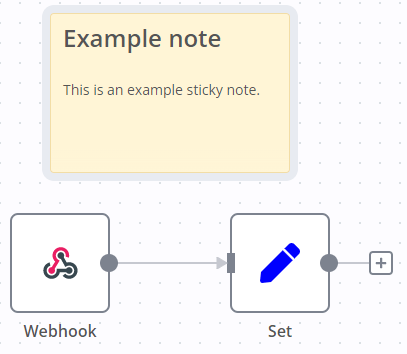](https://docs.n8n.io/_images/workflows/components/stickies/example-sticky-note.png)
### Create a Sticky Note
Sticky Notes are a core node. To add a new Sticky Note:
1. Open the nodes panel.
2. Search for `note`.
3. Click the **Sticky Note** node. Appizap Workflow Builder adds a new Sticky Note to the canvas.
### Edit a Sticky Note
1. Double click the Sticky Note you want to edit.
2. Write your note. [This guide](https://commonmark.org/help/) explains how to format your text with Markdown. Appizap Workflow Builder uses [markdown-it](https://github.com/markdown-it/markdown-it), which implements the CommonMark specification.
3. Click away from the note, or press `Esc`, to stop editing.
### Change the color
To change the Sticky Note color:
1. Hover over the Sticky Note
2. Select **Change color** 
### Sticky Note positioning
You can:
* Drag a Sticky Note anywhere on the canvas.
* Drag Sticky Notes behind nodes. You can use this to visually group nodes.
* Resize Sticky Notes by hovering over the edge of the note and dragging to resize.
* Change the color: select **Options**  to open the color selector.
### Writing in Markdown
Sticky Notes support Markdown formatting. This section describes some common options.
```markdown
The text in double asterisks will be **bold**
The text in single asterisks will be *italic*
Use # to indicate headings:
# This is a top-level heading
## This is a sub-heading
### This is a smaller sub-heading
You can add links:
[Example](https://example.com/)
Create lists with asterisks:
* Item one
* Item two
Or created ordered lists with numbers:
1. Item one
2. Item two
```
For a more detailed guide, refer to [CommonMark's help](https://commonmark.org/help/). Appizap Workflow Builder uses [markdown-it](https://github.com/markdown-it/markdown-it), which implements the CommonMark specification.
### Make images full width
You can force images to be 100% width of the sticky note by appending `#full-width` to the filename:
```markdown

```
---
# Agent Instructions: Querying This Documentation
If you need additional information that is not directly available in this page, you can query the documentation dynamically by asking a question.
Perform an HTTP GET request on the current page URL with the `ask` query parameter:
```
GET https://docs.appizap.ae/appizap-workflow-builder-pro/workflows/sticky-notes.md?ask=
```
The question should be specific, self-contained, and written in natural language.
The response will contain a direct answer to the question and relevant excerpts and sources from the documentation.
Use this mechanism when the answer is not explicitly present in the current page, you need clarification or additional context, or you want to retrieve related documentation sections.